


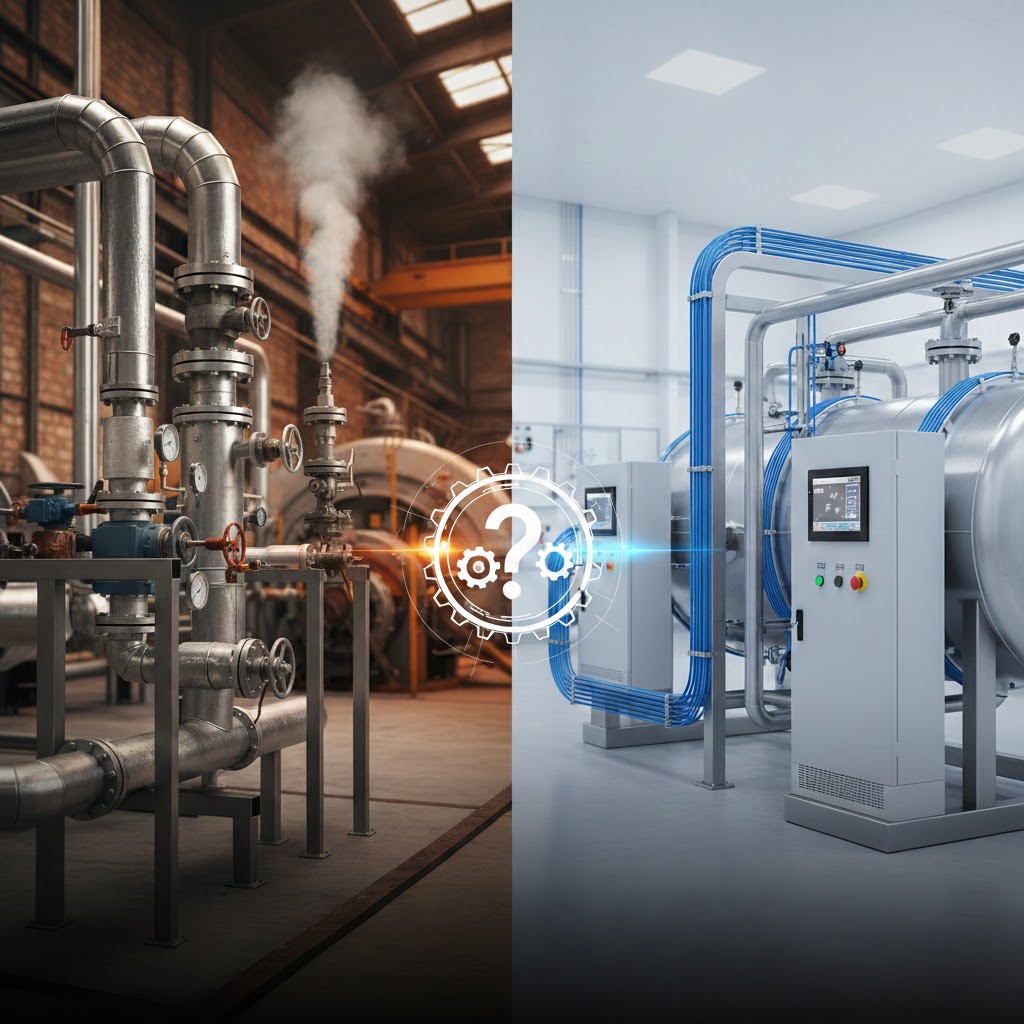
Industrial Heating Systems: Which Applications Suit Steam vs. Electric Solutions?
When heating requirements arise in industrial facilities, two primary choices usually come to the table: steam heating systems and electric heating solutions.
Both approaches deliver effective results under the right conditions. However, picking the wrong system does more than just drive up energy costs—it introduces maintenance overhead, operational complexity, and process risks.
Therefore, the right question is not “which one is better?”, but rather
“which one is right for which application?”
Where Does Steam Heating Excel?
Steam heating has been a proven method for decades, particularly in applications requiring high heat transfer rates. The latent heat carried by steam offers significant advantages in specific processes.
Steam heating typically stands out in scenarios such as:
- High-temperature process requirements
- Facilities with an existing centralized steam infrastructure
- Large-volume equipment heating, such as tanks and hoppers
- Applications requiring continuous and homogeneous heat transfer
However, these systems come with the trade-offs of complex piping, condensate management, and intensive maintenance demands.
Why Are Electric Heating Systems Gaining Popularity?
Electric heating systems have seen growing adoption in industrial settings, driven largely by their control precision and installation flexibility.
Key advantages of electric systems include:
- Precise temperature control
- Modular and scalable architecture
- Lower overall maintenance requirements
- Targeted, localized heating capability
- Seamless integration with plant automation systems
For applications like heat tracing on process lines and freeze protection, electric heating delivers a far more predictable solution.
Comparing Energy Efficiency
While steam systems theoretically offer high heat transfer capacity, real-world factors can drag down their efficiency:
- Line heat losses
- Condensate line inefficiencies
- Insulation degradation
Conversely, electric heating systems apply thermal energy directly at the exact point of demand. This localized approach yields higher efficiency, particularly in applications requiring localized and continuous temperature maintenance.
Maintenance and Operational Realities
Maintenance for steam systems is notoriously involved, demanding routine inspection of:
- Steam traps and condensate drainage equipment
- Valves and actuators
- Pressure control regulators
Electric systems shift the maintenance focus toward monitoring and diagnostic measurements. Modern control systems make it possible to detect performance drops long before a failure occurs.
This stark difference plays a major role in long-term total cost of ownership.
Evaluating Process Safety
Both technologies can be rendered safe when engineered correctly. However, electric systems hold an edge in safety-critical environments due to:
- Faster thermal response times
- Tighter temperature regulation
- Automated monitoring and alarm logic
These capabilities allow electric systems to catch temperature excursions much earlier, a crucial advantage in sensitive chemical processes and hazardous locations.
Which Solution Makes Sense Where?
In summary:
- Tanks, hoppers, and large-volume heating requiring high heat transfer: Steam heating
- Pipelines, process temperature maintenance, and freeze protection: Electric heating
- Applications demanding tight temperature tolerances: Electric heating
- Plants with existing, excess steam capacity: Steam heating may hold the economic edge
The right decision requires weighing site infrastructure, process requirements, and long-term operating goals together.
Conclusion
Steam and electric heating systems are not rivals; they are complementary engineering solutions tailored to distinct requirements. Moving away from direct, apples-to-oranges comparisons toward application-specific evaluations leads to far better outcomes for both safety and operating costs.
In industrial environments, selecting the proper heating system impacts not just immediate operations, but the facility’s long-term operational performance.
SAMM Technology – Heating | Thermon Heating Solutions
SAMM Technology’s Heating Department provides industrial facilities with tailored options through Thermon’s full range of electric heat tracing systems and steam heating solutions. From piping networks to tank and hopper heating, Thermon’s product portfolio is engineered around process safety and thermal consistency. Backed by technical expertise, SAMM Technology helps facilities evaluate and implement the exact heating system their specific applications demand.