


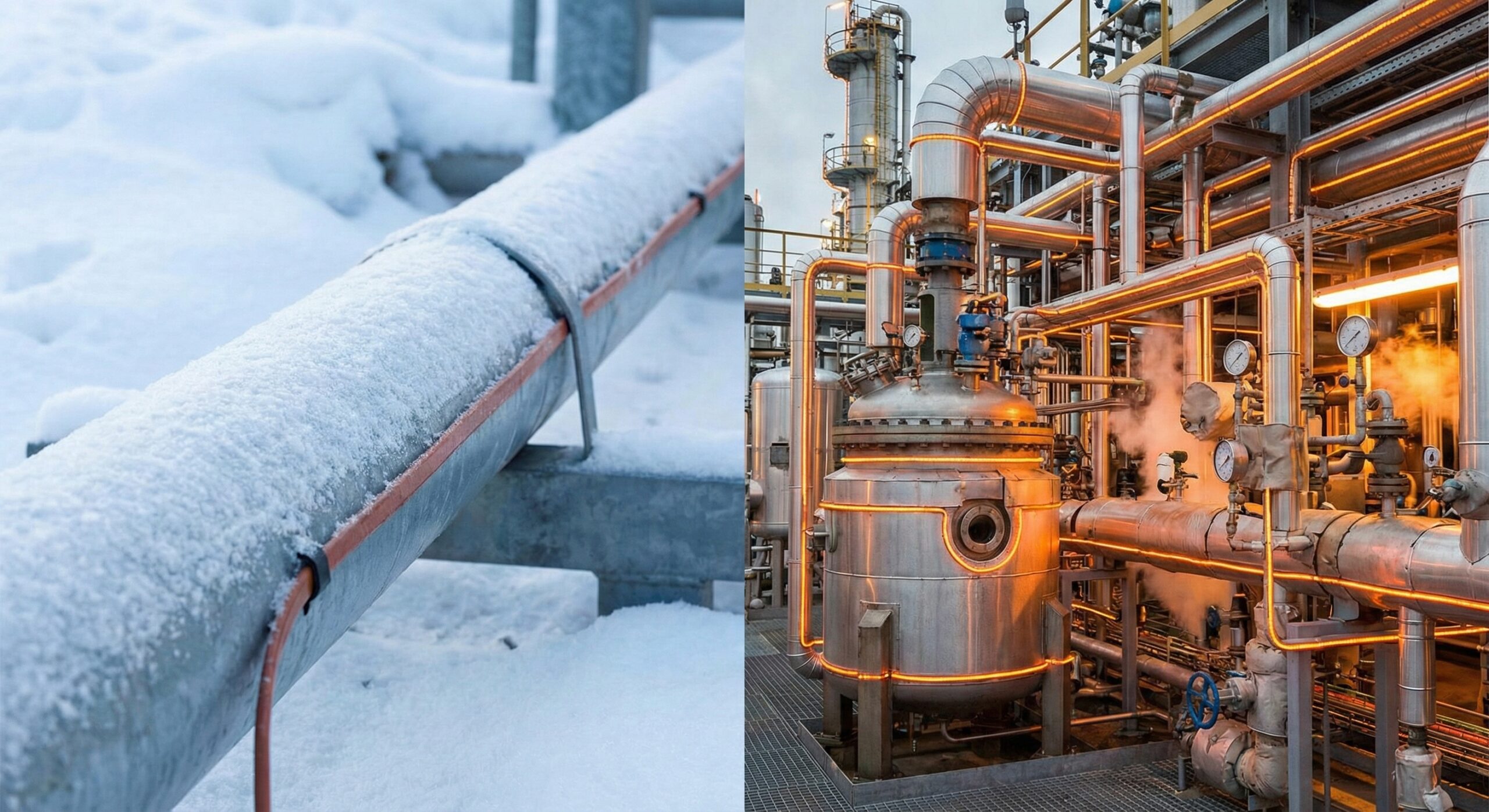
In industry, when heat tracing is mentioned, the first thing that usually comes to mind is the same:
“Preventing pipes from freezing.”
Yes, this is true. But it is incomplete.
Because in modern industrial plants, heat tracing systems no longer play a role solely in freeze protection, but a critical one in process safety, operational continuity, and quality stability.
Preventing a pipeline from freezing is not enough on its own. The real question is this:
Is the process running uninterrupted and predictably within the targeted temperature range?
Why Is Temperature Control Critical in Industry?
In chemical, petrochemical, energy, food, or pharmaceutical plants, temperature is not merely a “comfort” parameter; it is a variable that directly dictates production quality and safety.
- Fluid viscosity depends on temperature
- Reaction rates remain stable within specific temperature ranges
- Temperature deviations disrupt production tolerances
- Uncontrolled cooling → process downtime → cost
At this point, industrial heat tracing systems stop being just cables heating a pipe; they become the silent insurance of the process.
Heat Tracing = Continuous and Controlled Thermal Management
In the traditional approach, heat tracing is designed to “prevent freezing at the coldest point.”
However, in sound engineering, the goal is to:
- Keep fluid temperature within a narrow tolerance band
- Provide consistent process behavior regardless of ambient conditions
- Prevent sudden temperature deviations that disrupt production
This is why, in modern facilities, heat tracing design begins with these questions:
- Which temperature range is critical?
- At what point does temperature fluctuation become a process risk?
- Are insulation, cable type, and control system operating in harmony?
Even Without Freezing, Risks Remain
A common misconception on-site is:
“No freezing means no problem.”
However, significant risks can arise even in the absence of freezing:
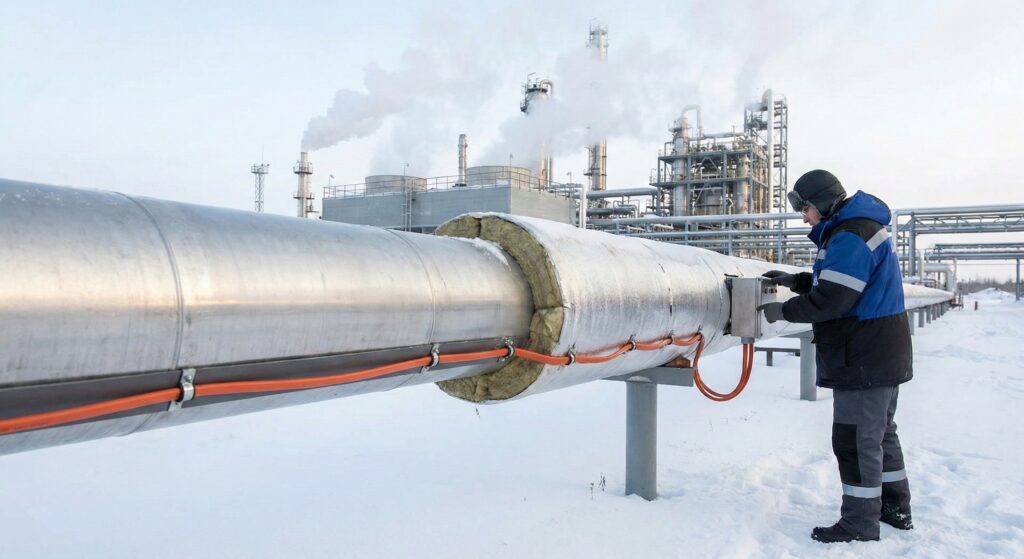
- Fluid slows down, pressure builds up
- Condensation starts, causing measurement errors
- Reaction times extend
- Energy consumption increases uncontrollably
Therefore, heat tracing should be addressed not only based on “freezing temperatures,” but by factoring in process temperature, flow characteristics, and operational scenarios.
The Role of Heat Tracing in Process Safety
A properly designed heat tracing system:
- Reduces process downtimes
- Makes maintenance interventions scheduled and planned
- Decreases reliance on operator intervention
- Makes safety risks predictable
Especially in explosive or hazardous environments, letting temperature slip out of control can lead to serious consequences, not just for production, but for plant safety as well.
As a result, heat tracing in industrial facilities should no longer be treated as an “auxiliary system,” but evaluated as an integral part of the process safety architecture.
Why Should Industrial Heat Tracing Systems Be Handled Holistically?
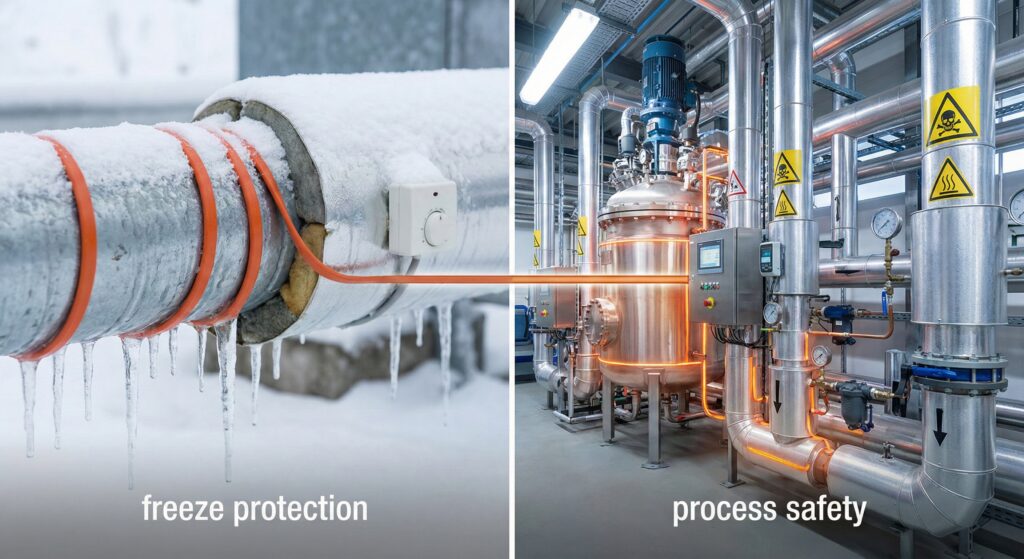
Selecting the right cable alone is not enough. An effective system requires the combined performance of:
- An appropriate heat tracing cable
- Correct insulation thickness
- An intelligent control and monitoring system
- Environment-appropriate certification (ATEX, IP, etc.)
working together seamlessy.
Systems deployed without this holistic approach may seem to function in the short term, but will generate energy loss, failures, and process risks over time.
Conclusion: Heat Tracing Is Not an Insurance Policy, It Is a Strategy
Installing industrial heat tracing simply to “keep pipes from freezing” wastes most of its true potential.
A properly designed heat tracing system:
- Keeps production stable
- Enhances process safety
- Optimizes energy consumption
- Makes plant operation predictable
In short:
Heat tracing is not a cost item; it is a process strategy.