


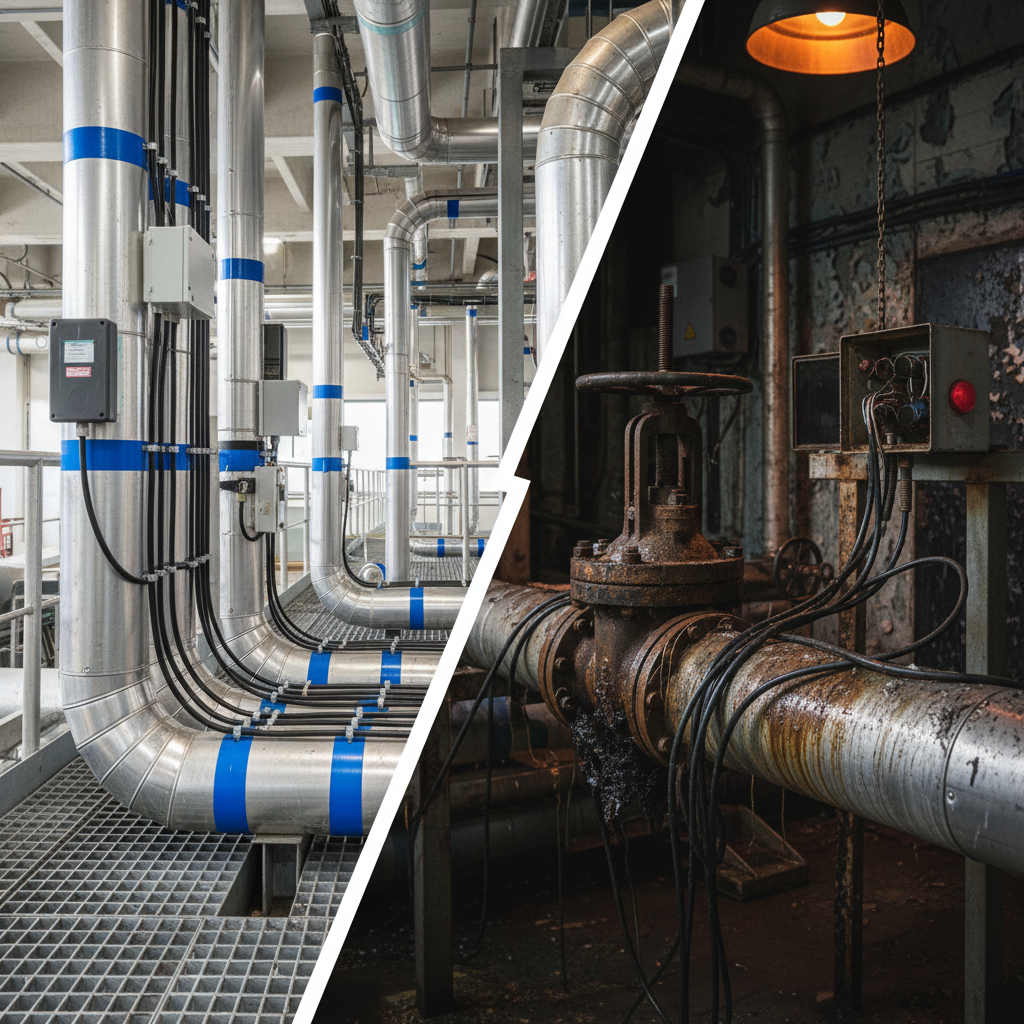
Self-regulating heat tracing cables are among the most widely used electric heat tracing solutions in industry. Their ability to automatically adjust output power based on ambient temperature makes these cables an attractive choice for numerous applications.
However, the majority of issues encountered in the field do not stem from product defects, but rather from design and installation errors. Incorrect choices—even if unnoticed in the short term—create serious long-term risks for process safety and operational continuity.
In this article, we cover the 7 most common critical design mistakes to avoid when using self-regulating heat tracing cables in industrial facilities.
1. The Misconception That Self-Regulating Cables Fit Every Application
One of the most widespread errors is assuming self-regulating heating cables are suitable for every environment and process. In reality, these cables have strictly defined limits regarding maximum exposure temperature, maintenance temperature, and environmental classifications.
When process temperatures exceed these thresholds, the cable degrades over time and its power output permanently drops—silently undermining system performance.
2. Selecting Power Ratings Against the Wrong Reference Point
Heating cables are typically selected using watt-per-meter ratings specified at a defined reference temperature (e.g., 0 °C or 10 °C). Making a selection without accounting for this reference temperature leads to underperformance in the field.
Incorrect power selection manifests as insufficient heating in colder zones and unnecessary energy consumption in milder ones.
3. Leaving Thermal Insulation Out of the Design
A heat tracing system consists of more than just the heating cable. Thermal insulation is a foundational component required for the system to operate efficiently.
In projects where insulation thickness, material, or installation quality are overlooked, even the correctly chosen cable will fall short. Poor insulation ultimately leads to higher energy consumption and increased operational risk.
4. Cable Overlaps at Flanges, Valves, and Complex Details
Although self-regulating cables can be cut to length and routed dynamically, improper routing at detail points like flanges and valves can cause localized heat buildup.
Such overlaps result in insulation deformation, reduced cable lifespan, and temperature imbalances across the piping.
5. Dismissing Control and Monitoring Systems as Unnecessary
The mindset that “it’s self-regulating, so it doesn’t need control” remains surprisingly common in the field. However, without dedicated control and monitoring systems, it is impossible to verify whether a cable is actively operating or experiencing power loss over time.
This oversight ensures that faults are only discovered after the process has already ground to a halt.
6. Overlooking Environmental Certifications
Heating systems used in industrial facilities must hold the appropriate certifications for their operating environment. ATEX ratings and IP protection classes are especially critical in explosive or hazardous locations.
Specifying the wrong product or accessories can compromise the safety of the entire facility, not just the heating system.
7. Taking an “If It’s On, It Works” Approach to Maintenance
A system that is energized is not necessarily operating correctly. Over time, self-regulating cables can lose their thermal characteristics, resulting in lower power output.
In systems lacking periodic measurement and monitoring, these performance drops go unnoticed until they result in unplanned process downtime.
Conclusion
When properly engineered, self-regulating heat tracing cables offer reliable and efficient solutions. However, projects built on flawed assumptions quickly turn these advantages into liabilities.
A successful heat tracing system requires a holistic approach: pairing the correct cable selection and power calculations with appropriate insulation and effective control systems. In industrial operations, heating errors often start quietly—but they end up costing a fortune.
SAMM Technology – Heating | Thermon Solutions
SAMM Technology’s Heating Department delivers comprehensive industrial heat tracing solutions powered by Thermon, featuring self-regulating heating cables, control and monitoring systems, and end-to-end design for demanding industrial environments. Engineered to maintain process temperatures, mitigate freeze risks, and ensure operational continuity, Thermon systems provide long-term reliability when applied with a sound engineering approach.